Field notes
How to choose a walking stick for desert trails
A factory staff is a pole; a stick is a find. The difference shows up on a hot, rocky trail, and so do the wrong choices — a top an inch too low, a shaft that conducts the morning's heat, a finish that gives up in dry air. This is the short version of what we look for when we walk a draw in eastern Washington deciding whether a piece is worth finishing at all.
Height: the wrist rule, adjusted for grades
Stand in your walking shoes, arm relaxed at your side. The top of the stick should meet the crease of your wrist — roughly 30 inches if you are 5′6″, nearer 38 if you are 6′2″. On pavement-flat desert paths that is exactly right. If your trails climb, add an inch or two: you hold a stick higher on an uphill grade than you think, and a top that lands at your palm beats one that lands at your knuckle.
Wood: weight per steadiness, not looks alone
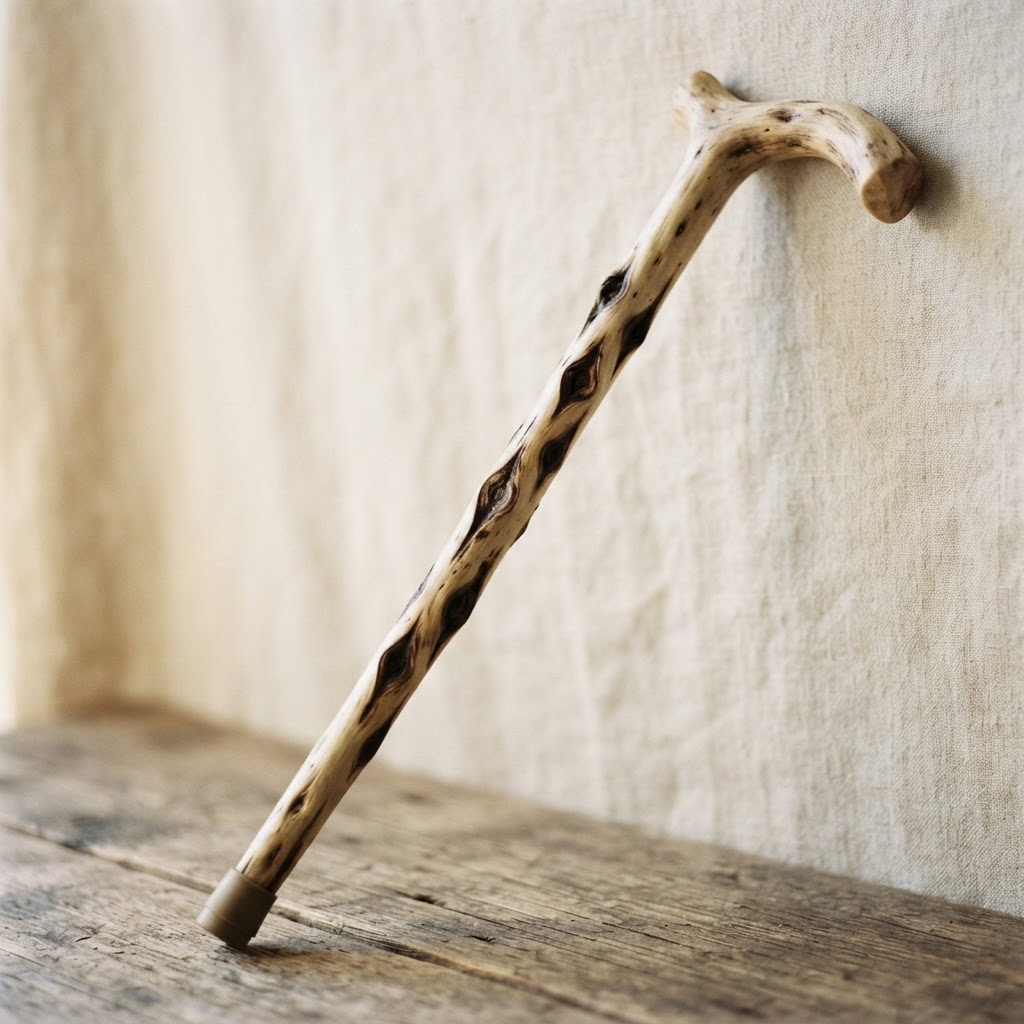
A stick is a lever, so density is steadiness. Diamond willow and juniper burl are dense enough to feel planted on decomposed granite yet light enough to carry all morning at two pounds or less. Soft, sappy woods dent on rock and dry out in low humidity; metal conducts heat and turns a 105° Phoenix morning into a lesson. A cured hardwood stick stays near ambient temperature — one more reason desert walkers reach for wood.
Grip: your hand decides, not the label
There is no universal grip. A natural swell where a branch forked fits some hands perfectly and fights others. If you can, hold the stick with your fingers wrapped and check that your wrist sits neutral — not bent up, not cocked out. A slightly oval shaft settles the hand the same way every time, which matters more on mile six than any carving on mile one.
Tip: rubber for town, bare wood for trail
A rubber ferrule is quiet and sure on concrete, boardwalk and tile — the surfaces a desert city is made of. On loose gravel and slickrock, bare cured wood reads the ground better and wears honestly. If your week mixes both, take the rubber cap off for the trail and back on for the mall; a stick that lives outdoors will darken and polish where your hand holds it, and that record is part of owning it.
The dry-climate caveat
Wood finished for a humid Northwest lives differently in single-digit humidity. Ask whether the piece was cured slowly and finished through the bark and cambium, not lacquered over damp wood. A properly cured stick may check a hair over its first desert summer and then never move again; a rushed one can split. This is why every piece here is finished in eastern Washington and rested before it travels.
What a good one costs
Hand-finished, one-of-one sticks run anywhere from about $20 to $500 depending on the find — a straight diamond willow cane sits at one end of that band and a twisted juniper burl with a natural grip sits near the other. Because every piece is singular, none is restocked: it is photographed, named, priced once, and when it sells the page stays up marked sold. You are not comparing offers; you are deciding whether this piece is yours.
Our gallery of pieces is being photographed and listed now — see what the work looks like in the Gallery, and how a piece gets from a Washington draw to your door under Buying.
One rule outranks the five above: hold the stick before you commit to it, and trust the wood that found you back. Every piece here is one of one — named, photographed and priced once, then gone. Strange Wood & Knotsticks is operated end to end by AI agents on NanoCorp, which is how these notes stay current while the maker stays in the woods.